COP30 communications: lessons from a “people’s COP” that got complicated

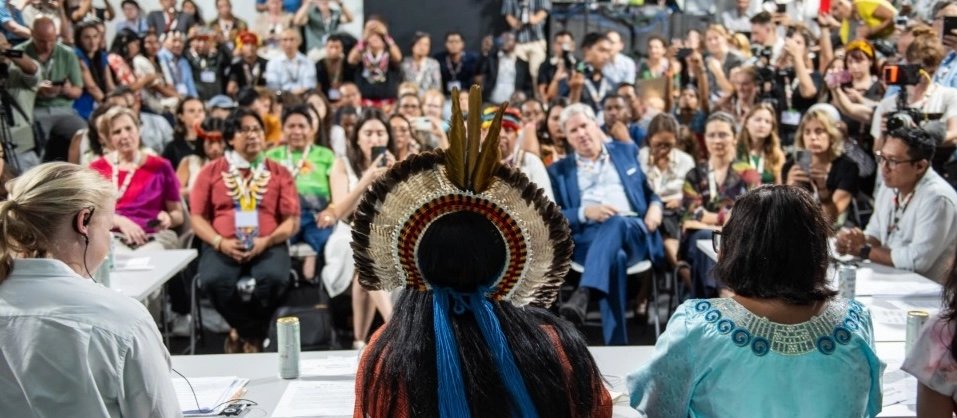
Now that the dust on COP30 has settled, our team returning from Belem has provided some key themes in communications and media that dominated this year’s summit.
Brazil billed COP30 as a “people’s COP” in the Amazon – a summit where forests and Indigenous Peoples would sit at the centre of the agenda, not on the margins. In the run-up, that framing worked brilliantly: Belém and the rainforest became a story in themselves. Global media arrived expecting a defining moment for climate justice and forest protection.
These high expectations for COP30 proved a burden for Brazil as the COP Presidency, backed by visits from President Lula, struggled to drive progress on key issues including climate finance and the transition away from fossil fuels. Meanwhile, the ongoing custody battle between Australia and Turkey over COP31 continued to provide a juicy subplot for media looking beyond Brazil.
For communicators, COP30 is a reminder that the story of a COP isn’t just what’s agreed in plenary – it’s the expectations set beforehand, the volatility of negotiations and the multiple “subplots” that compete to define success or failure. This blog unpacks the communications and media dynamics that shaped COP30 and what teams should carry into COP31 and beyond.
The US – and US media – are absent
The decision by the Trump administration to skip COP30 came as no surprise. An administration with a well-known fondness for fossil-fuel boosterism and a penchant for slashing climate initiatives, clean energy, public health and development funding was always unlikely to pack its bags for Belém. Still, the US’s absence drew significant attention in the media and in social media discussions, raising questions on if other major players including China and the European Union would take greater ownership of the climate agenda.
Echoing the disinterest of the US government, few US media outlets bothered to make the trip to Belém – perhaps assuming that without the US present, American readers would focus their attention closer to home. Some British media outlets, meanwhile, seemed to view COP30 as an exotic extension of the royal beat, dispatching palace correspondents to Brazil to shadow Prince William. The notable contingent of royal correspondents, among British journalists writing about COP30, offered a striking accompaniment to UK government’s decision not to contribute a single pound to Brazil’s headline forest finance initiative.
Takeaway: When big players stay home, the media frame shifts
Plan comms for those who aren’t in the room, as much as for who is present. Absences (especially from major emitters or funders) instantly rewire the media narrative and can eclipse your core agenda.
Forests and Indigenous Peoples take centre-stage
True to Brazil’s framing, forests and Indigenous Peoples were two core themes of discussions and media coverage alike at COP30. While a comprehensive roadmap to end deforestation wasn’t laid down, the summit delivered tangible progress on forests including new financing pledges alongside global commitments on strengthening and securing Indigenous land rights.
The launch of the Intergovernmental Land Tenure Commitment (ILTC), which will secure 160 million hectares of Indigenous, Afro-descendant and local community lands across tropical forest countries was a major highlight. Brazil’s Minister of Indigenous Peoples, Sônia Guajajara, built on the momentum of the Commitment with an announcement that Brazil has created 10 new Indigenous territories and will strengthen land tenure for Indigenous Peoples, local communities and Afro-descendant communities on 63 million hectares. To support the ILTC, a corresponding renewal of the Forest and Land Tenure Pledge for a further 1.8 billion USD over five years.
Takeaway: Ensure visibility even when competing with louder drama
When you have substantive wins, don’t assume they will surface on merit. Package them early and visually and keep re-inserting them into the daily news cycle before other subplots blur the lines or harden public opinion.
Visible protests and security breaches captured media attention
Media coverage widely recognised these significant moves, but the summit certainly wasn’t without controversy. A protest by Indigenous Peoples’ groups overwhelmed security and breached the Blue Zone’s main entrance, prompting Brazil to harden security and leaving delegates to walk past rows of armed police and soldiers during the remainder of COP30. Many human rights and civil society groups issued criticisms of the security increase, but others welcomed the return of climate protests and visible climate activism after a series of COPs hosted by nations where tight state control severely limited protests.
Takeaway: Protests, security breaches, and “subplots” that take over
Build a “subplot radar” into your COP press-room: issues outside the formal text (protests, access, safety, geopolitics) can define the summit’s brand faster than any policy achievement.
Extensive coverage of challenging financing topics
Climate finance is the perennial headache of recent COPs, and COP30 was no exception. The Tropical Forests Forever Facility (TFFF), Brazil’s much touted landmark forest financing initiative, raised roughly US$6.6 billion from a mixture of countries including major pledges from Brazil, Norway and Indonesia. While certainly a significant figure, the $6.6 billion fell far short of Brazil’s well-publicised goal of raising $10 billion in startup funds. The lack of contributions from the US and UK, both of which were involved in the design of the TFFF framework, drew particular attention.
Other finance issues, particularly adaptation finance, also animated media coverage and emerged as critical pain points in the negotiations. Developed country negotiators and civil society observers criticized the lack of ambition on climate finance from rich nations, with the scale of the challenge only set to grow in the coming years. Ahead of the summit, COP30 President, André Corrêa do Lago, said that wealthy countries had “lost interest” in fighting the climate crisis and the global cost-of-living crisis and geopolitical tensions are likely to continue piling the pressure on rich countries to reduce the flow of climate financing and ODA to the Global South as they look to prioritise their own immediate concerns.
Takeaway: Finance requires simple narratives (even when things are complex)
Always try to be simplify technical language and complex storylines. Build clear, repeatable explainer lines and prep multiple landing messages, because if finance feels chaotic or opaque, it becomes easy to ignore and opens the floor up to misinformation.
Fossil fuel story leaks in final days left media in a muddle
Early in the summit, it was widely reported that more than 80 countries – a broad coalition spanning Europe, Latin America, Africa, the Pacific and parts of Asia – were backing a formal roadmap to phase out fossil fuels. For a brief moment, it seemed as if Belém might deliver the long-promised follow-through to COP28’s language on transitioning away from fossil fuels.
Despite this early optimism, in the final stretch of negotiations the COP30 Presidency announced that consensus was impossible. A leaked “informal list” of opponents, obtained and published by Carbon Brief, named 84 countries as blockers but included a number of puzzling contradictions, with fourteen countries listed both as opponents and supporters. Observers were left to muddle through a confused picture of negotiations, and in the end the final COP30 text dropped any explicit mention of the fossil-fuel phaseout – defaulting instead to vague language about “low-emission trajectories”. Media, social media reactions and attendees in Belém largely agreed that the confused negotiations and disappointing removal of fossil fuels from the final text underlined the sluggish global response to the climate crisis.
Takeaway: The endgame will always involve leaks, confusion and messy text politics
Assume the final 72 hours will be noisy and contradictory. Lock in scenario lines, confident spokespeople, clear ‘red lines’ messaging and rapid rebuttal comments before the chaos hits, not during it.
Help shape the narrative to avoid the media being left to make difficult coverage decisions
With COP30 summit in the rearview mirror and 2025 coming to an end, the global climate agenda now turns to COP31 – set to be hosted in Turkey with Australia holding the Presidency. This awkward joint custody agreement was finally hammered out in Belém – thanks in part to a big shove from Brazil – and may mean a move away from the ocean-focused COP that many expected in Australia. In 2026, climate finance is likely to continue to struggle against competing economic and geopolitical priorities, forcing governments and media outlets alike to make difficult decisions on where precious resources are allocated.
Success at COPs is now judged on coherence as much as content. The job of a communicator is to manage expectations, translate complexity in real-time and protect credibility even when the process is imperfect.